Sunday, April 20, 2014

What I've Learned...


Wow!! There have been a lot things we have covered this semester regarding consumer behavior like cultures, subcultures, how consumers make decisions, how we see ourselves, and many other things related to consumer behavior.  The main take-aways for me from Predictably Irrational was things like the power of the word "free" and how procrastination affects us as people. It was interesting to learn about how irrational we are as consumers and how we make our decisions. In in the book Nudge, I learned about the two ways of thinking which were the automatic and reflective systems. The reflective system is deliberate, while the the automatic system is instinctive. I learned how we can "nudge" consumers to make decisions. I really liked the chapter about culture this semester, it was interesting to learn about how our cultures and rituals shape ourselves.  Overall, this has been an eye opening class and has taught me a lot about how consumers make decisions and what drives them.  

Saturday, April 19, 2014

Product Placement


.  
"Product placement is the insertion of real products in fictional movies, TV shows, books and plays" (Solomon, 2013, 555). Product placement can be both subtle and very obvious. The video below is an example of how products were placed in a recent movie, Man of Steel. According to the textbook, "Marketers pay $25 billion per year to plug their brands in TV and movies" (Solomon, 2013, 555).  Researchers believe that this act aids consumer decision making because of the familiarity with these items.  I found this really interesting when I stumbled upon this in the chapter about culture.  I never realized how common this occurs on TV and in movies.  It is everywhere!!! I mean I could go all day finding pictures and examples of how products are placed in today's society.  Product placement is like watching a commercial inside of a TV show or movie.  With the creation of Netflix and other media outlets, consumers are able to get rid of traditional commercials resulting in companies turning to product placement of their products in different media forms. I have also listened to songs that seemed to have an audio version of product placement in them, for example..."Apple bottom jeans, boots with the firm...etc.." I am afraid that diving deeper into this topic may have ruined movies, TV shows and music for me. We shall see.  

Here is another movie that compiles different examples of product placement.  

Hoarding and Collecting


Hoarding: Buried Alive has become a popular TV show in more recent times that shows people and their masses of stuff that they gather over years and stash away in their home. "Hoarding according to the textbook is the unsystematic form of collecting" (Solomon, 2013, 542). Every time this behavior is portrayed on television it proves to be problematic. These people are being either removed from their homes if they don't improve the situation, their children are moving out or being taken away, or they face huge fire danger. Below is a video about a lady who hoards....

Collecting is different than hoarding because it refers to the "systematic acquisition of a particular object or set of objects" (Solomon, 2013, 542). So instead of collecting everything they only collect certain things.  I think most children at some point start collections of some sort, when I was in the second grade I collected rocks.  "Some consumer researchers feel that collectors acquire their "prizes" to gratify their materialism in a socially acceptable manner" (Solomon, 2013, 542). 
I feel like most of us either have some sort of connection to a person who hoards or collects items. My grandma could be considered an organized hoarder.  She has taken pictures of most of the items in her home where she has them organized in boxes and puts those pictures in binders for people to look through. She has random stuff boxed up in piles in her house and those boxes are everywhere!! One example of something she has in her house is these fabric swatches from probably the 1960's or 70's that are old and outdated but she saves them and intends to use them to sew things.  

It is interesting to think about how people can get so attached to products.  I think some of it a generational thing where they want to save things because of the tough times they lived through and some of the hoarding can be attributed to psychological issues.  Collectors and hoarders seem to spend huge amounts of time devoted to building up their collections and maintaining them. These activities becomes a "central component of their extended selves" (Solomon, 2013, 542).  

Thursday, April 17, 2014

Effectiveness of a Good Salesperson


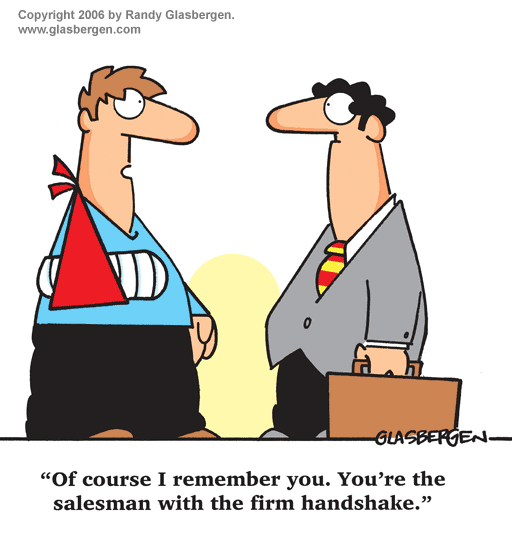
After working almost two years in the quilt store, I have learned a lot about how to relate to customers and how to move more product out the door, but it hasn't always been this way.  I used to just look at a customer blankly in the face when they would ask me a question that I didn't know the answer to.  I probably looked like an idiot.  When I first started working for the store I didn't know any of the customer's names and didn't know where anything was located in the store. Inexperience and my youthfulness was working against me when I began my job. When I read the section about what defines a salesperson's role and effectiveness I thought of real life examples from my work experience for each of the factors they listed.  The list included age, appearance, educational level and motivation to sell (Solomon, 2011, 353). I learned in order to gain respect from the customers in the quilt store there is a certain appearance I need to maintain or else customers will think I am just some snot nosed kid. I had to change some of the clothing stores I normally shop at to give me a more mature wardrobe.  I have also learned that salespeople need to build strong relationships with their customers.  A strong relationship creates loyalty that keeps customers coming back to you for future sales.  Customers with a strong relationship will seek you out.  I think good sales people also possess integrity and usually customers will recognize this quality and it will reflect on the salespersons sales.

After reading about the effectiveness of salespeople, I wanted to learn about some of the things I could do now to be more profitable in my current job.  The following is the 7 Highly Effective Habits of Sales People:

1. They Make a Good First Impression
According to scientific studies, you have very little time to make an impression when meeting someone new. About seven seconds, in fact. And if it’s not a good impression, you’ll struggle to overcome it. Top salespeople know that it's important to look sharp and speak well during those first meetings with prospects and customers, because that’s how they will be remembered.

2. They have a Positive Attitude
People want to associate with others who are enthusiastic and who have an overall positive attitude. Of course, everyone has bad days, but the best salespeople don't display these feelings in front of clients. They take a day off or, better yet, develop personal techniques to manage those emotions.

3. They Take Notes
A few minutes after a meeting, most people will have already forgotten huge portions of what the other person said. So, when top salespeople hear important information--during, for instance, a meeting with a decision maker about a sale--they take notes. The clients will remember what they asked for and the promises they were made. Top salespeople remember, too.

4.They Keep their Commitments
Trust is a key component in any relationship, and it is especially important in sales. When top salespeople make promises, they keep their commitments, reinforcing to clients that they can be trusted.

5. They Know their Stuff
Top salespeople know everything there is to know about their products and their competitors. But, above all, they know their customers' needs. According to a survey of customer-buying attributes we conducted, the top reasons buyers selected a particular supplier was because they felt that the salesperson understood their needs best.

6. They Welcome Complaints
The best salespeople don't shy away from criticism or become defensive when they encounter a complaining customer. In fact, they welcome these situations. Surveys have shown that when customers complain, it signals that they actually want to keep doing business with the company--provided the problem is addressed. 

7. They Never Give Up

A sales career isn't always easy. Sometimes--like when you lose a big sale or a big customer--it can be downright depressing. But, even in the worst of times, success is often right around the corner. Rather than give up, the top-performing salespeople concentrate on all the reasons they can succeed. And they find a way to win.

http://www.inc.com/john-treace/7-habits-of-highly-effective-salespeople.html

Sunday, March 23, 2014

Ownership in Basketball


While reading Predictably Irrational by Dan Ariely, there were many themes that stuck out to me and found interesting.  One topic that Dan Ariely discusses is people and ownership. He found that, "The more work you put into something, the more ownership you begin to feel for it" (Ariely, 175). I think that this is completely true especially when I reflect on myself, especially when I am making quilts.  Ariely also made a point that, "Ownership is not limited to material things.  It can also apply to points of view or an idea--like sports" (Ariely, 175).  When I read that sports can be something that people take ownership in I immediately thought about the March Madness basketball tournaments.  I am not a huge basketball watcher but I have watched my boyfriend and his residents (He is an RA) and how they have responded to the current tournaments. All I have been listening to them talk about is what is happening in their brackets and screaming at the top of their lungs at their TVs.  It's crazy to see people get so worked up about basketball. One of my boyfriend's residents on his floor (and also his next door neighbor) was cheering alone in his room at the top of his lungs saying things like, "Let's go (team name here)!!" He chanted this over and over until someone else from the floor went and pounded on the kid's door telling him to shut up.  Then the cycle would just repeat again after a few minutes of silence.  It has been funny to see how these boys have claimed their teams and brackets and taken so much ownership in the madness. It has been interesting to see how Dan Ariely's observations in his book have become evident in other real life examples.

Nike Fuel Band--Brainstorming

Last Thursday I went and listened to the people from R/GA talk about the Nike Fuel Band. Wade Convay gave the most insight about the development and brainstorming process of the Fuel Band.   When they first started the project, they wanted the fuel band to become something that people grab when they walk out the door, “Keys. Phone. Wallet. Fuel band.” He talked about how his team used a storyboard method and put sticky notes on a board to brainstorm the fuel band product. He also mentioned that the team looked to other ideas on how to brainstorm for the fuel band.  Brainstorming creates new ideas, solves problems, motivates and develops teams. Brainstorming motivates because it involves members of a team in bigger management issues, and it gets a team working together. Brainstorming is a crucial part of the development of any product in order to create something that consumers want to purchase and use.


The Brainstorming Process.... 
  1. Define and agree the objective.
  2. Brainstorm ideas and suggestions having agreed a time limit.
  3. Categorize/condense/combine/refine.
  4. Assess/analyse effects or results.
  5. Prioritize options/rank list as appropriate.
  6. Agree action and timescale.
  7. Control and monitor follow-up.
www.businessballs.com/brainstorming.htm 

Monday, March 17, 2014

The Power of Suggestion---Hypnotism

In Chapter 11 of Predictably Irrational by Dan Ariely, the power of suggestion is brought up and discussed in terms of medical placebos (Ariely, 230).  I found this chapter a little concerning because placebos can be unethical in my mind at times. He mentioned the study a doctor did where he conducted placebo surgeries on patients. I think I would be a little ticked off if I found out later that I paid for the doctor to make a small incision in me and not do anything to me but just sew it right back up.  He talked about how in this placebo surgery experiment the doctor discovered that the real procedure did not actually help the patients and they felt the same as the people that underwent the placebo surgery.  When I read the words "power of suggestion" it immediately reminded me of hypnotism. Even though Ariely does not directly hit on the topic of hypnotism in his book I would be curious to see if his thoughts and this topic are somehow related.  

According to one website I found, "The American Psychological Association describes hypnosis as a cooperative interaction in which the participant responds to the suggestions of the hypnotist. Hypnosis has  been clinically proven to provide medical and therapeutic benefits, most notably in the reduction of pain and anxiety. It has even been suggested that hypnosis can reduce the symptoms of dementia". So hypnosis isn't just all fun and games at fairs and in Vegas, it could be beneficial mentally and physically.  After reading about some of the positive effects of hypnotism I started wondering if it wasn't just another placebo. In hypnosis people respond to the suggestion of the hypnotist and with placebos people respond to the feeling (stated on a pill bottle or by a doctor) one should expect from like a pill or operation. For instance, if people know they are going to experience less pain after being hypnotized do they really experience less pain or do they just think they are feeling less pain? Kind of interesting to think about.... I find hypnotism really interesting and I think Dan Ariely should do an experiment about people that are hypnotized.  


The video below is kind of interesting if you don't think it is really real, at least it is entertaining! 

My Big Fat Greek Wedding

After watching Bend It Like Beckham in class, I started thinking of other movies that possessed similar themes.  One of the movies that I liked growing up was My Big Fat Greek Wedding that came out in 2002.

If you haven't seen this movie I recommend it, its pretty funny.  It is about a Greek woman living in Chicago, named Toula.  Toula's father wants her to marry a nice Greek boy.  In the movie, Toula ends up falling in love with a non-Greek man (Ian) and sneaking behind her family's back to date him. Her family ends up discovering her secret and her father is especially angry about her secret love life. Toula's father ends up accepting Ian and Ian has to learn to accept Toula's family. The clip below is how Toula's father reacted to her announcement of her engagement to Ian.
One theme in the movie that become very apparent early on is conformity.  According to the textbook conformity is "a change in beliefs or actions as a reaction to real or imagined group pressure" (Solomon, 2013, 414). One example of conformity in My Big Fat Greek Wedding is when Ian is baptized in a Greek church in order to marry Toula and gain respect from her family.


Another theme that is apparent in this movie is social power.  Social power is "the capacity to alter the actions of other" (Solomon, 2013, 407).  In the movie the Greek culture is portrayed to have a big portion of their diets consist of meat.  When Toula tells her aunt that Ian is a vegetarian and does not eat meat her aunt is really confused by the idea, but quickly responds that instead of meat she will make lamb.  This is an example of how Toula's aunt tries to alter Ian's actions in order to conform to the rituals of their Greek family.

If you have not seen My Big Fat Greek Wedding I recommend it because it has many themes similar to Bend it Like Beckham.  The idea of groups of people and cultures is embedded into the movie and pop up frequently.  

Tuesday, February 18, 2014

The Quilting Lifestyle

So I am starting to catch myself blogging about quilting and my job at the quilt store in just about every blog I write.  This one isn't going to be any different. Recently, I was reading in the textbook about people's lifestyles and how these lifestyles formed a person's identity. It was interesting to read on page 470 that "people in the same social and economic circumstances may follow the same general consumption pattern" (Solomon, 2013, 470). I couldn't help but tie this to my current job at the quilt store.
It has been really interesting working with the customers at the store as a clerk.  The quilt store has a very interesting customer base which is unique compared to many other stores.  It is unique due to the fact that most of the customers that come into the store are middle to upper-class retired women. They are the people that own $12,000.00 sewing machines and will spend $200.00 in fabric in a day. Some of the customers come in every week to either shop, look around the store, or come to classes. These ladies are the intense quilters.  They have made quilting their lifestyle because they spend most of their time and large amounts of money on the hobby.  Quilting is an expensive hobby and takes a lot of time, but in my opinion a relaxing, productive way to spend time.  The expensive sewing machines, fabric, and projects one can make are the building blocks behind this lifestyle. 
The quilt store where I work isn't just a place where the women get their fabric, it is also a place that builds community among these quilters.  In the store, we all work really hard to memorize customer names, remember the projects they are working on, or even asking about their families (if they share that information with us).  The sense of community only fuels the quilting obsession and makes customers feel like they are more at home in the store and will more than likely spend more in the store. It has been interesting working at the quilt store and advancing more toward one of the ladies that have a quilters lifestyle. :)

Sunday, February 16, 2014

The Customer is Always Right

If you didn't already know this about me yet, I work in a local quilt store in Bozeman.  I work as a clerk and help customers with questions and problems that may arise on their quilting projects.  The one thing that my job has taught me that has been very valuable for the future is the importance of good customer service. Good customer service at the quilt store is the difference between a sale and the potential customer turning around and walking right out the door.

Last week I was shopping for a new dress and was able to see the clear difference between good and bad customer service. I went into the first store and was looking at racks and holding stuff up and shuffling through sizes, I probably spent 20 minutes looking and pulled four dresses off the racks to try on.  I then proceeded to the back of the store toward the dressing rooms passing both of the clerks (who were talking to each other and didn't even acknowledge my presence).  I went to a dressing room and tried on my dresses.  I felt really out of place and even though I liked a few of the dresses I tried on, I left them there because I felt awkward being there. I walked out of the dressing room past the two clerks again (still didn't say anything) and right out the front of the store.

I kind of wanted to give up on the shopping process all together that day, but as I walked past another store I decided that maybe I would just look around and see if there were any dresses that I liked.  I walked into the store and was immediately greeted by the only clerk in the store.  She came up to me and asked me how I was and then asked what I was looking for.  I told her I was kind of looking for a dress and she immediately started pulling dresses off the racks for me to try on.  She got me into a dressing room and I tried on all the dresses and liked a few (the only problem I had with them was the quality of the fabric). I didn't end up buying any at that store because the fabric felt like poor quality and the workmanship on the dresses wasn't up to par. If I wasn't such a fabric snob (result of working at a quilt store) that store clerk would have had a sale! She even followed up with me when I was leaving the store and asked if she could find anything else for me. I felt bad leaving and I really did want to buy something from her. So how does good and bad customer service effect consumer behavior?

Customer service has a huge impact on how people spend money and where they shop. It all ties back to a person's emotions.  If someone feels unwelcome or threatened in an environment, they more than likely aren't going to stick around and are definitely not going to financially support it. People will spread bad reviews faster than a person can snap their fingers.  Take a gander at the picture below and absorb how much of an impact poor customer service can have on a business. I think it is important especially for smaller stores to greet every customer that walks in the door and make sure they are doing okay.  I work really hard at the quilt store (even when it is really busy) to give each customer the attention that they demand.  So in my mind customer service doesn't slightly effect consumer behavior, it DRIVES it!!!

bad customer service consequences Why you need a social customer service program

Wednesday, February 5, 2014

Why Buy Local?


The mentality behind buying items locally versus the internet or corporate chain stores like Walmart has always fascinated me.  I remember my dad always driving his gas sucking pickup across town to go to the gas station that was more expensive, but was owned locally to fuel up his truck. I would ask him why he did that and he always responded with, "I like to help out the local businesses in town".  That was the only reason I ever got from him and it still always left me curious on why the heck he would spend more money and go out of his way for a local business?!! What's in it for him?

I also began to see signs of this mentality when I started working at a local quilting store.  Customers would come into the store and ask for off the wall items that a store like ours would never stock.  I would always direct these customers to a website or even Joann's Fabrics and more often than not they would come back with the response that they would rather not go to those places and wanted to get it locally.  So there we have it again...some people are willing to go out of their way and spend more money to support local businesses. So why is this? Is it something people do to make them feel good about themselves or is something that is economically sound? 

After doing some further investigation, I learned about the local multiplier effect. The idea in summary is how the more money one spends locally, the more money will be reinvested into the local economy. Think about it...if you spend money at a local store, that local business will use that money to pay their local employees and hire local service providers like accountants, etc.  These employees and service providers are the people who shop in the community and if they spend their money locally the cycle will continue, but if they don't shop locally the cycle will slow and negatively effect the local economy.  Let's say consumers decide to shop at Walmart instead of a local store.  The money that would have gone into local service providers is now being sent to Walmart headquarters where CEO's and other's salaries are being extracted.  That money is not going back to the community in which it came from, and instead is going to fund the Walton family bunker. (The video below is clip of a video my teacher in high school showed his class. Pretty enlightening even if it is 10 year old data.)   You can see more graphs about shopping locally in the graphs above. 

So not only does shopping locally give you a warm fuzzy feeling inside, it also boosts your local economy! So maybe my dad and the quilt store customers are on to something here....there are some major benefits to buying locally. This is something I am going to keep in mind the next time I decide to go shopping at a store. I need to ask myself...where is my money really going?   

Monday, January 20, 2014

About Me....

I thought I would start out this semester of blogging with a little about myself.  I am from Lewistown, Montana (a small town in the exact center of the state). I love to be outside! I recently started bow hunting and I love it!! It's a blast!

My First Elk! This was at an archery tournament in Lewistown
this past summer. 
I also learned that I really love fishing! I still have a lot to learn though. These fish are real, unlike the elk on the left!
My first fishing excursion!! Summer 2013


I am a third generation Bobcat, so it was destiny that I attended MSU for college.  I am a business management and marketing major and I am also pursing a minor in small business and entrepreneurship. I currently work part time at Main Street Quilting Company in Bozeman. I have been quilting for over ten years now.


This is one of my first quilts (left) that I made in high school.  It is one of my favorites because it has a lot of small pieces and I really love how the pattern looks.  I entered this quilt into a competition and won a sewing machine in a People's Choice competition.


I made this applique giraffe wall hanging (right) for my sister last year for her birthday.  My sister is obsessed with giraffes! It was a new challenge for me because I individually cut out all the little pieces by hand and fused them with my iron as layers onto the background fabric.

The quilt on the left I made in 2013 for my dad for Christmas. The darker blue triangles are pieces of his old jeans. I had a lot of fun picking out the fabric for this quilt. I didn't want it to be too feminine so I tried to pick out more manly colors.

It has been interesting working in a quilt store these past two years.  I have been able to observe a lot about what people (mostly women) are looking for in projects, colors, and products.  I have had experience first hand with a small business and what works and what doesn't.  I hope to incorporate my learning experiences from the quilt store into my future consumer behavior blogs. It will be interesting as I go throughout this semester and learn more about consumers and their behaviors to see what I can apply to the quilt store.